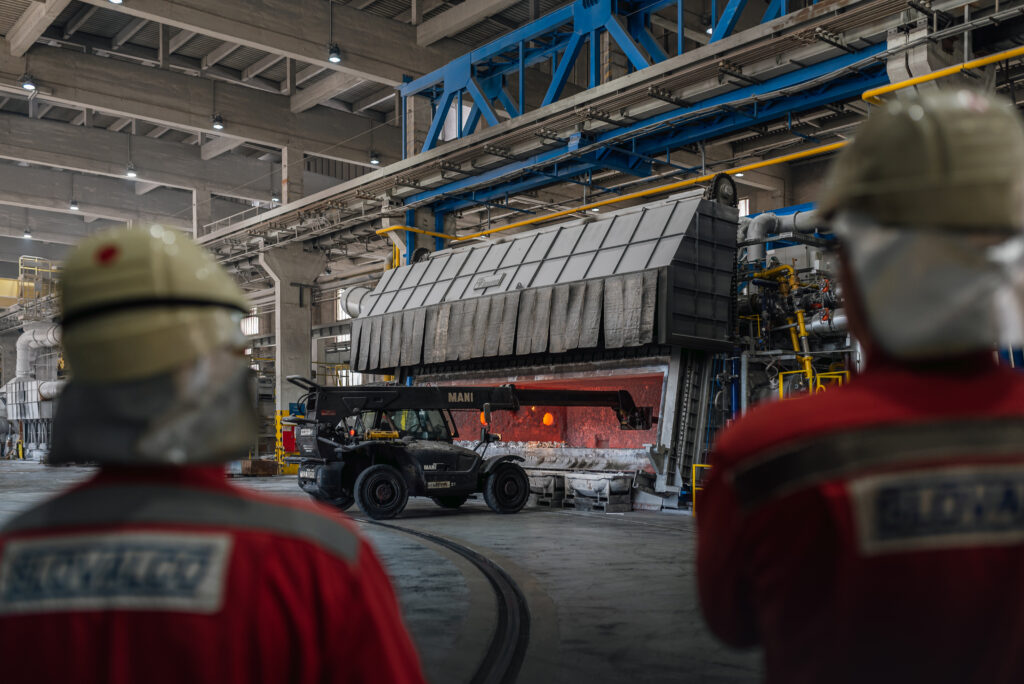
After more than three years, Slovakia is returning to the ranks of countries that produce primary aluminium. Slovalco, a joint venture of Hydro and Penta Investments, has begun the gradual restart of production in Žiar nad Hronom. In the first phase, it will restore annual production capacity of 75,000 tonnes of aluminium. The company will invest at least EUR 100 million in the restart, and the resumed production will support more than 200 jobs.
Following the start-up of the first electrolysers, the gradual return of primary aluminium production is beginning at Slovalco. Production was completely halted at the beginning of 2023.
The resumption of production is the result of several months of cooperation between Slovalco, its owners and the Slovak Republic. It follows the Memorandum of Understanding signed in February 2026 and the subsequent agreement with the Slovak Republic of 1 July 2026, which created a longer-term and more predictable framework for the operation of energy-intensive production.
“What we were still speaking about as a possibility only a few months ago is becoming a reality today. After more than three years, we are once again beginning to produce primary aluminium. It is the result of the enormous efforts of our employees, the company’s owners and the constructive approach of the state.
Thanks to the positive approach of the government, we have succeeded in creating conditions that once again give aluminium production in Slovakia an economic perspective. For Slovalco, the region and Slovak industry, this is an exceptionally important moment in restoring strategic industrial production in Slovakia,” says Milan Veselý, CEO of Slovalco.
The return of strategic production to Europe
The significance of Slovalco’s restart extends beyond the plant itself and the Žiar nad Hronom region. Aluminium is one of the European Union’s critical raw materials and is an essential input for energy, transport, the automotive and electrical engineering industries, construction and defence.
At the same time, Europe is becoming increasingly dependent on imports of primary aluminium. Imports cover more than half of European demand, and in recent years the production capacity of European aluminium smelters has also been significantly reduced as a result of high energy prices.
Slovalco is one of the most technologically advanced and energy-efficient aluminium smelters in Europe. The metal produced has a many times lower emissions footprint than metal imported from third countries. Resuming its production will therefore not only strengthen the security of supply of a strategic raw material and reduce European industry’s dependence on production from third countries, but will also contribute to a reduction in overall emissions.
At least EUR 100 million for the resumption of production
The technological restart itself is being financed by Slovalco. The company has committed to investing at least EUR 100 million in the resumption of production. The funds are being directed to the technical preparation of equipment, the gradual start-up of electrolytic pots, securing operations and other investments needed for a safe and reliable return to production.
The resumed production will also support more than 200 direct jobs and hundreds of indirect jobs and will help preserve specialised technical know-how that has been built up at Slovalco over decades. The restart will also create opportunities for suppliers and other companies linked to the operation of the aluminium smelter.
“Retaining key employees and professional expertise during the period when production was shut down was one of the decisive prerequisites for today’s restart. An aluminium smelter cannot simply be switched off and then turned back on with the press of a button after several years. Behind today are months of intensive technical preparations and years of work by people who believed that production could return to Žiar nad Hronom,” adds Milan Veselý.
Conditions comparable with other industrialised EU countries
For the first time since the introduction of the emissions allowance system, the state is creating conditions intended to enable aluminium production in Slovakia to remain competitive in the long term. This mainly involves compensation for indirect CO₂ costs, which are reflected in electricity prices as a result of the European emissions trading system.
Compensation for indirect ETS costs is a standard instrument of European industrial policy, used by several Member States in accordance with European rules. Its aim is to limit the risk of production being relocated to countries where producers do not bear comparable costs associated with carbon production. The same mechanism is also used by other energy-intensive companies in Slovakia.
The restart will continue gradually
Starting the first electrolysers does not mean an immediate return of the plant to its full production capacity. Individual parts of the electrolysis operation will be brought online gradually.
The first phase of the restart represents 75,000 tonnes of annual capacity. Any potential restoration of the remaining part of the total capacity of approximately 175,000 tonnes will be decided on the basis of future framework conditions, the market situation and the availability of competitively priced electricity.
By resuming production, Slovakia will once again, after more than three years, join the European countries producing primary aluminium.